
6 Sins of American Reading Instruction: What’s Holding Students Back

A couple of years ago, I noticed something unsettling. My daughter had just finished kindergarten, and she wasn't close to reading on her own. Her teacher mentioned that kids her age aren't expected to start reading yet, but I felt uneasy. Instead of learning how letters link to sounds and how to blend those sounds into words, she was memorizing whole words and even entire books. She was also encouraged to guess words by looking at pictures. But when she came across new words she'd never seen before, she was completely stuck.
I couldn't leave this to chance. So, I began digging into how reading is taught in our schools. What I discovered was both surprising and concerning. Despite all the resources we have in the United States, our education system is struggling to teach children the most fundamental skill: reading. In fact, 37% of fourth graders read below the basic level, according to the National Assessment of Educational Progress.
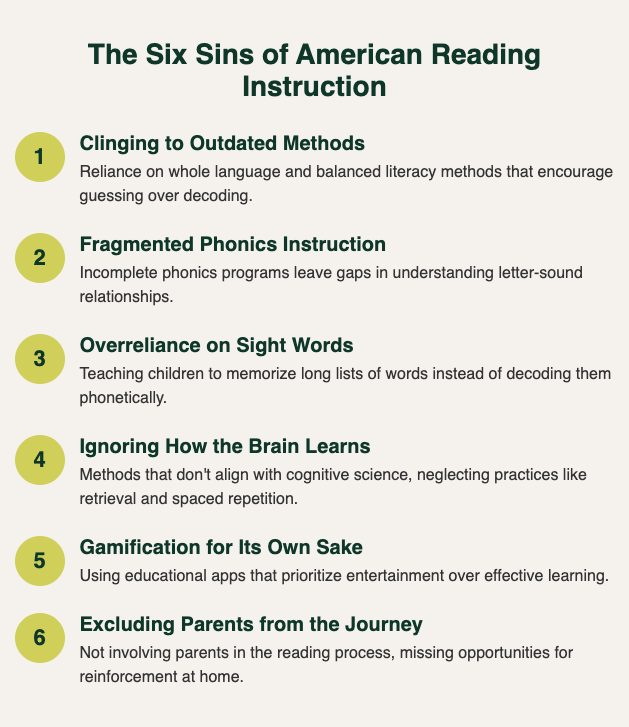
As a mom of two and a researcher in education, I felt compelled to understand why this is happening. I spent hundreds of hours studying research on teaching reading, trying to unravel the mystery. Along the way, I uncovered six major issues that I believe are holding our kids back. I think of them as the "Six Sins of American Reading Instruction."
By shedding light on these problems, I hope we can start a conversation about how to better support our children in becoming confident, proficient readers. Let's explore what these six sins are and how we can address them together.
Sin 1: Clinging to Outdated Methods
One of the biggest hurdles in American reading instruction is our stubborn attachment to outdated methods like whole language and balanced literacy. Despite overwhelming research showing these approaches are ineffective, they continue to dominate classrooms across the country. While many states have officially shifted toward phonics-based instruction, change is slow. Teachers have been trained for years in these older methods, and many teacher training programs still promote them.
Why This Is a Problem
The whole language approach and its "evolved" version, balanced literacy, are based on the belief that children learn to read words as whole units. The idea is that if children are exposed to enough books, reading will happen naturally, much like how we learn to speak. While that sounds appealing, it's not how the brain processes written language.
Whole language approach supporters believe that reading is a natural process that can be picked up as naturally as speaking through observation and exposure to engaging books. The truth is reading is not natural for the brain. Our brain was evolving for the last 200,000 years at least. While the brain was evolving, we naturally developed predispositions for certain skills. For example, walking and speaking. We have specific brain areas that were evolutionarily developed to learn these skills by observation.
Reading, on the other hand, is a relatively new phenomenon for humanity. It appeared only about 5000 years ago when writing was invented. We don't have brain areas that are predefined for reading. Instead, certain areas of our brain get reused and rewired to be able to read. This rewiring needs to be explicitly taught and guided.
The National Reading Panel (2000) concluded that systematic phonics instruction is far more effective than whole language methods. Children taught through phonics make greater gains in reading accuracy and comprehension compared to those taught to guess words from context.
Research by Torgesen (2002) showed that whole language approaches fail to adequately teach decoding skills, especially for struggling readers. Without explicit instruction in phonics, many children fall behind in reading fluency, and these gaps widen over time.
Jeanne Chall's research in "Learning to Read: The Great Debate" (1967, 1996) debunked the whole language theory decades ago. She showed that children need explicit phonics instruction to become proficient readers by linking letters to their corresponding sounds.
These outdated approaches encourage guessing over decoding. When kids encounter an unfamiliar word, they're often told to use context clues—like pictures or the surrounding text—to guess the word. Guessing might work for simple books with lots of pictures, but as kids progress to more complex texts, they struggle if they haven't learned to decode words by breaking down their letters and sounds.
So why are these methods still widespread?
It comes down to resistance to change. Teachers have been trained in whole language and balanced literacy for years, and it's hard to unlearn something that's been ingrained. These methods also seem more "natural," prioritizing reading whole books and encouraging creativity over teaching the mechanics of reading. But while creativity is important, it can't replace the essential skill of decoding.
Another reason is that teacher training programs still promote these methods. There's a gap between what research shows and what's happening in the classroom. Until this gap closes, we'll continue to see kids fall through the cracks.
The Impact on Kids
When children rely on guessing instead of decoding, it sets them up for failure. Their reading growth is slow, and they miss out on building fluency. By middle or high school, many students develop anxiety about reading, viewing it as something they're just not "good at." In reality, it's not that they can't read; it's that they were never taught how to read effectively.
This is especially problematic for children from low-income or non-English-speaking households, where literacy support at home may be limited. If these kids aren't receiving strong, systematic phonics instruction at school, they fall even further behind.
What Needs to Change
To help our children become proficient readers, we need to leave behind whole language and balanced literacy once and for all. We should fully embrace phonics-based instruction, training teachers in comprehensive phonics approaches and giving them the tools to help every child succeed.
Sin 2: Fragmented and Incomplete Phonics Instruction
Phonics instruction is undeniably effective, but the way it's implemented in many classrooms is often incomplete and fragmented. Instead of offering a comprehensive phonics program, schools tend to provide bits and pieces, leaving significant gaps in children's understanding of how written language works.
Why This Is a Problem
Phonics teaches the relationship between letters and sounds. But many schools teach only basic phonics, covering a limited set of letter-sound correspondences. Children may learn how to decode simple words like "cat" and "dog," but when they encounter more complex words like "though" or "bright," they're stuck. This incomplete knowledge forces them to resort to guessing or memorization. As we discussed in Sin 1, the overreliance on guessing can lead to bad habits and hinder reading development.
In "Uncovering the Logic of English," Denise Eide emphasizes the importance of teaching the complete code of English, which includes 75 phonograms and 31 spelling rules. Most phonics programs are fragmented and fail to provide children with the comprehensive knowledge they need to decode 98% of English words.
Because phonics instruction often leaves gaps, children are taught to memorize certain words as whole units, referred to as "sight words." The idea is that some words are too irregular to be phonetically decoded. However with the right phonics instruction, about 98% of English words can be decoded and as we'll explore further in Sin 3 over relying on memorization of long lists of sight words has a negative impact on the reading progress.
The Long-Term Consequences
Children who don't receive comprehensive phonics education are more likely to struggle with reading accuracy and fluency as they advance through school. By the time they reach higher grades, they often face complex texts that require strong decoding skills. Without those skills, reading becomes a laborious process, and they may begin to avoid it altogether.
What Needs to Change
Schools need to implement comprehensive phonics programs that cover all the phonograms and spelling rules—not just the basics. This means teaching children the full range of letter-sound correspondences and how to blend sounds together to form words. Phonics should be integrated into every aspect of the literacy curriculum, giving children ample opportunities to practice and reinforce their skills.
Sin 3: Overreliance on Sight Words and Memorization
A common misconception in American reading instruction is that children need to memorize a long list of sight words—words they are expected to recognize instantly without decoding. This practice is unnecessary and counterproductive to a child's long-term reading development.
The Myth of Irregular Words
The sight word approach is based on the idea that many English words can't be decoded because they don't follow usual phonics rules. These are called "irregular" words. However, proper phonics instruction can explain approximately 98% of English words. Only a small fraction of words truly defy standard phonics rules.
For example, words like "said," "friend," or "does" might seem irregular, but they can be explained by phonics patterns when taught correctly. Teaching children comprehensive phonics reduces the need for rote memorization.
Why Memorization Fails
Relying on memorization is inefficient. The human brain can store about 2,000 individual symbols. The average adult vocabulary includes around 60,000 words and with the fragmented phonics nearly half of the words considered “sight” words . Memorizing thousands of words is nearly impossible for young children. Phonics gives them the tools to decode new words on their own.
Lost Opportunities for Reinforcement
Memorizing sight words instead of learning to decode with comprehensive phonics deprives children of valuable practice. Every word is a chance to practice phonograms and apply spelling rules, reinforcing their decoding skills. When kids are encouraged to memorize words, they miss out on this practice.
Additionally, forcing children to memorize words as whole units takes valuable time away from decoding practice. Without the ability to decode unfamiliar words, children become overly reliant on the few words they know by sight, and their reading progress slows as texts become more complex.
The Long-Term Impact
Overemphasis on sight words creates a barrier to independent reading. Children may read simple texts that rely on high-frequency sight words but struggle with more complex literature that contains a wider range of vocabulary. This lack of decoding skills also impacts comprehension and spelling.
What Needs to Change
We need to shift away from having children memorize long lists of sight words. Instead, we should focus on teaching comprehensive phonics that covers all essential phonograms and spelling rules. This approach equips children to decode any word they encounter, enabling independent reading and improving accuracy and fluency.
Sin 4: Ignoring How the Brain Learns to Read
Reading isn't a natural skill like speaking; it's something we have to teach and learn. This means our teaching methods need to align with how the brain processes and remembers information. Unfortunately, many popular reading programs are designed without this understanding, leading to ineffective strategies.
The Brain's Role in Reading
Reading involves multiple brain areas that work together to recognize letters, connect them to sounds, blend those sounds into words, and understand meaning. The process of decoding—breaking words down into their letters and sounds—is essential for fluent reading. When children are taught to decode properly, they strengthen the neural pathways necessary for reading fluency and comprehension.
Many methods, especially those rooted in whole language or balanced literacy, encourage children to guess words from context or pictures rather than decoding them. This goes against how the brain is wired to read. Skilled reading requires breaking words down into their smallest units so the brain can efficiently process and store them.
Overemphasis on sight word memorization also bypasses the brain's natural phonological processes and relies on limited visual memory. These strategies, as discussed earlier, don't build long-term reading proficiency.
Many programs also don’t incorporate teaching practices rooted in cognitive science. For example, methods like retrieval practice, spaced repetition, and ensuring consolidation have been found highly effective for retaining information. By not incorporating these evidence-based practices, many reading programs fail to support how the brain naturally retains information.
When teaching methods don't match how the brain learns, children often experience frustration and low confidence in their reading abilities. They may struggle with unfamiliar words and feel like reading is "too hard." This misalignment is particularly harmful for children with dyslexia or other reading difficulties.
Research shows that effective reading instruction needs to be explicit, systematic, and aligned with the brain's natural processes. This means teaching children how to decode words step by step, starting with simple sounds and gradually building up to more complex ones. Multi-sensory learning techniques also engage multiple parts of the brain, reinforcing connections between letters, sounds, and meanings.
Sin 5: Gamification for the Sake of Gamification
Educational apps and programs have become a significant part of how reading is taught, especially for young children. While technology has its place, the trend of turning reading lessons into games often prioritizes entertainment over real learning.
Gamified learning seems like a great idea—it’s engaging and fun. However, the focus on rewards in many of these apps shifts emphasis away from mastering skills. Children may engage in shallow tasks that don't translate into real reading skills, leaving parents thinking their child is progressing when they're missing foundational skills.
Overuse of gamification encourages excessive screen time. Studies show that too much screen time can negatively affect children's development, including attention span and social skills. Prolonged use can impact vision, sleep, and cognitive development (Madigan et al., 2019, Hale and Guan, 2018, Chang et al., 2020).
Many gamified programs focus on surface-level tasks, like matching pictures to words, which don't teach decoding or blending sounds. Children might earn points in a game but struggle to apply those skills to real-world reading tasks.
The skills developed in these games often don't transfer to real reading. Children might perform well in an app but struggle with actual books. Extrinsic rewards can overshadow the intrinsic motivation to learn, making reading a task to complete for rewards rather than an enjoyable activity.
How Technology Can Be Used Effectively
Technology can be a powerful tool when used thoughtfully:
Reinforce, Not Replace: Apps should supplement traditional reading instruction, not replace it.
Choose Wisely: Select programs that focus on decoding skills and meaningful reading practice.
Limit Screen Time: Balance screen-based activities with hands-on learning and reading physical books.
Encourage Active Learning: Use technology that promotes active engagement with reading skills.
We need to rethink how technology is used in reading instruction, ensuring it supports, rather than undermines, real learning. Parents and educators should prioritize evidence-based programs and be mindful of screen time.
Sin 6: Excluding Parents from the Reading Journey
A vital aspect of a child's reading development is the role of parents. Often, reading instruction is treated as something that happens only at school, leaving parents out of the loop. This exclusion is a fundamental flaw in our approach to reading education.
Parents are a child's first and most important teachers. Research shows that parental involvement in early literacy has a direct positive impact on children's reading skills. Reading together creates shared experiences and fosters a love of learning.
Without reinforcement at home, children may not get enough practice to solidify their reading skills. Many parents aren't given the tools or knowledge to support their child's reading, especially in households where English isn't the primary language.
Teaching a child to read strengthens the parent-child bond. Reading together creates cherished moments and boosts a child's motivation to learn.
Parents know their children's interests and struggles, making them uniquely positioned to tailor reading instruction. When parents are excluded, opportunities for individualized support are lost.
To improve reading outcomes, we need to involve parents actively:
Provide Resources: Offer parents practical guides on supporting reading at home.
Collaborate: Maintain open communication between teachers and parents.
Encourage Daily Reading: Emphasize the importance of reading together daily.
Empower Parents: Provide workshops or resources on phonics and decoding strategies.
The six sins of American reading instruction have held back children for too long. But the solution is clear: we must adopt comprehensive phonics instruction, align teaching methods with how the brain learns, and involve parents in the process.
By focusing on evidence-based strategies, providing parents with the tools they need, and using technology wisely, we can cultivate confident, proficient readers. It's time to move beyond ineffective methods and embrace approaches that truly support children's long-term success in reading. Our children deserve the best possible foundation for lifelong learning, and that begins with giving them the right tools to read.
References
Chang, H.-Y., Park, E.-J., Yoo, H.-J., Lee, J.-W., & Shin, Y. (2020). Electronic media exposure and use among toddlers. Acta Paediatrica, 109(5), 985–992.
Chall, J. S. (1967). Learning to read: The great debate. McGraw-Hill.
Chall, J. S. (1996). Learning to read: The great debate (updated edition). McGraw-Hill.
Dehaene, S. (2010). Reading in the brain: The new science of how we read. Penguin.
Ehri, L. C., et al. (2001). Phonemic awareness instruction helps children learn to read. Reading Research Quarterly, 36(3), 250–287.
Eide, D. (2011). Uncovering the logic of English. Pedia Learning Inc.
Foorman, B. R., et al. (1998). The role of instruction in learning to read. Journal of Educational Psychology, 90(1), 37–55.
Hale, L., & Guan, S. (2015). Screen time and sleep among school-aged children and adolescents: A systematic literature review. Sleep Medicine Reviews, 21, 50–58.
National Institute of Child Health and Human Development. (2000). Report of the National Reading Panel.
Madigan, S., Browne, D., Racine, N., Mori, C., & Tough, S. (2019). Association Between Screen Time and Children's Performance on a Developmental Screening Test. JAMA Pediatrics, 173(3), 244–250.
Rayner, K., et al. (2001). How psychological science informs the teaching of reading. Psychological Science in the Public Interest, 2(2), 31–74.
Torgesen, J. K. (2002). The prevention of reading difficulties. Journal of School Psychology, 40(1), 7–26.

© FLUENT MINDS, 2024